Known as Knapp's Tavern during the American Revolution
Home : History : Photos : General Putnam : Directions
Putnam Cottage or Knapp's Tavern?
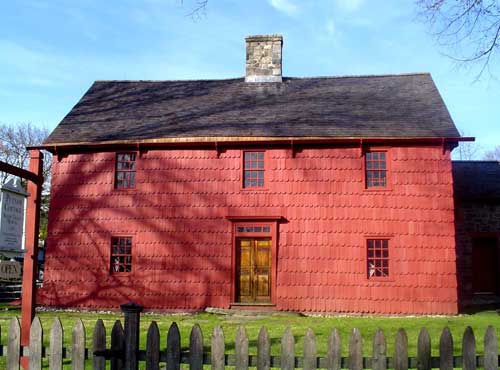
 This bright red house on the Boston Post Road has had a long and colorful history.
It was originally built in the 17th century and has grown over the years into its
current size and shape. During this time, a number of elements have both been added and
removed from the structure. The result is the current building that reflects the
changing attitudes of the various owners who have lived and worked there, rather
than just those of the original owners and builders. It is not a static object
from the 17th century, but a dynamic building that reflects the whole period of its
existence.
This bright red house on the Boston Post Road has had a long and colorful history.
It was originally built in the 17th century and has grown over the years into its
current size and shape. During this time, a number of elements have both been added and
removed from the structure. The result is the current building that reflects the
changing attitudes of the various owners who have lived and worked there, rather
than just those of the original owners and builders. It is not a static object
from the 17th century, but a dynamic building that reflects the whole period of its
existence. 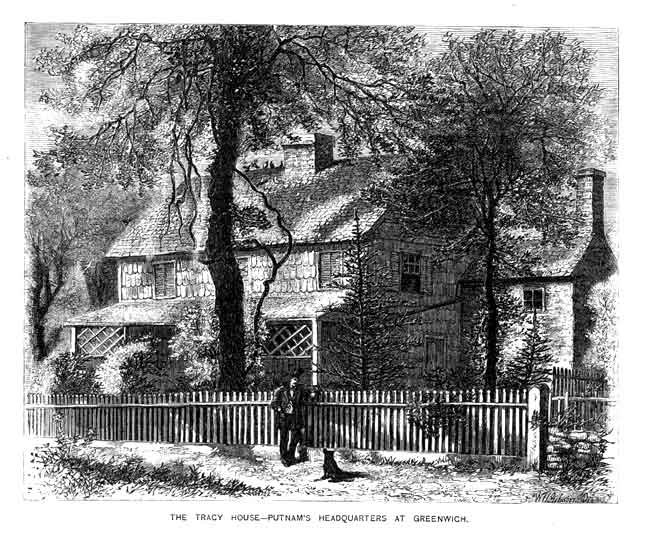 The house has long been associated with General Israel Putnam and his
heroic escape from the British during the Revolutionary War. By the middle of the
19th century, the link was firmly established in the community. The house was opened to
the public on the centennial of Putnam's ride and filled with relics from the
colonial era. The house was opened as a museum
in 1906 under the name Putnam Cottage. Generations of visitors have come to know the
building by this name. In actuality, the name is misleading. Putnam's association with
the building highlights just a brief moment in its history and the term cottage would
not have been used to describe such a substantial building in the 17th century.
The house has long been associated with General Israel Putnam and his
heroic escape from the British during the Revolutionary War. By the middle of the
19th century, the link was firmly established in the community. The house was opened to
the public on the centennial of Putnam's ride and filled with relics from the
colonial era. The house was opened as a museum
in 1906 under the name Putnam Cottage. Generations of visitors have come to know the
building by this name. In actuality, the name is misleading. Putnam's association with
the building highlights just a brief moment in its history and the term cottage would
not have been used to describe such a substantial building in the 17th century. The original house was probably built for the family of Timothy Knapp in the late
1600s. He and his wife, Martha Weeks, shared it with their son Isaac Knapp, Sr.
and his family, including his first two children. Later in the century it was used as a
tavern and the meeting place for the local Freemasons. It is intimately connected to the
Revolutionary war, having housed General Putnam and hosted General Washington and
his entourage for lunch.
The original house was probably built for the family of Timothy Knapp in the late
1600s. He and his wife, Martha Weeks, shared it with their son Isaac Knapp, Sr.
and his family, including his first two children. Later in the century it was used as a
tavern and the meeting place for the local Freemasons. It is intimately connected to the
Revolutionary war, having housed General Putnam and hosted General Washington and
his entourage for lunch.In the 19th century, the ceilings were raised, windows were changed and a porch was added to the front of the building. By the end of the century, the house had achieved the size and shape that it would retain through much of the 20th century.
 In 1901, a group of concerned citizen purchased Putnam Cottage and in November 1902, the deed
was presented to the Israel Putnam House Association, Inc. to maintain as a museum. Putnam Cottage is open to the public as an historical museum, as a learning center for area students, and
as a setting for Revolutionary War celebrations that bring a thrill and pride to people
of the Town and to visitors from all parts of the United States and abroad.
In 1901, a group of concerned citizen purchased Putnam Cottage and in November 1902, the deed
was presented to the Israel Putnam House Association, Inc. to maintain as a museum. Putnam Cottage is open to the public as an historical museum, as a learning center for area students, and
as a setting for Revolutionary War celebrations that bring a thrill and pride to people
of the Town and to visitors from all parts of the United States and abroad. In preparation for the country's bicentennial, Putnam Cottage Knapp Tavern underwent an extensive restoration. The purpose of this work was to remove the evidence of 19th century changes that had been made to the house, and to return it to a colonial appearance as well as make it conform to its modern uses. (more photos)